Category: Dailies

Overlooking Jason Kubel

While Justin Morneau has put himself on pace for career numbers and Joe Mauer has put himself on pace for historical numbers, the third wheel in the Minnesota Twins’ left-handed combination has been widely overlooked. 
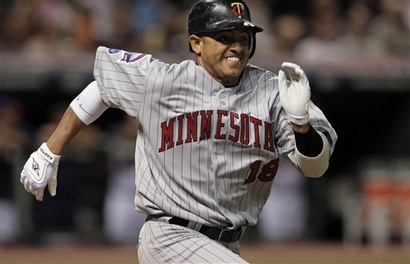
Jason Kubel entering the season had career highs of 20 homeruns and 78 runs batted in. With yet another productive game in the series opener with Cleveland on Friday night, Kubel continued to make progress toward a career year.
Kubel currently has 20 homeruns to match his career high, and is only 10 RBI shy of his career high in that category. With 46 games remaining in the season, Kubel finds himself on pace for 29 homeruns, 100 RBI, and quite possibly most impressive, a .312 batting average.
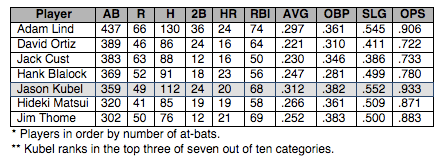
No doubt already overlooked behind Morneau and Mauer, Kubel has been overlooked among everyday designated hitters as well. Out of seven qualified designated hitters, Kubel finds himself at the top or in the upper tier in most categories. 
Kubel vs DH.pngThe numbers include totals from games where the players have moved into other positions on occasion, and while Kubel is behind Adam Lind of Toronto in the homerun and RBI departments, he has nearly 80 fewer at-bats.

With Kubel playing in the outfield on occasion, his numbers at the plate can be compared to other outfielders. Nelson Cruz was an American League All-Star this season, and Kubel stacks up quite well:
Kubel vs Cruz.png
While Kubel has hit five fewer homeruns, he has outdone Cruz in the batting average category by over 40 points and has 10 more RBI. He also has a higher slugging percentage and his on-base percentage is nearly 50 points higher.
Stacked up against his fellow designated hitters and All-Star Nelson Cruz, Kubel proves to be no slouch. Amongst all American Leaguers, Kubel ranks 10th in batting average, 7th in OPS, and 6th in slugging. 
On pace for career numbers, totals that will place him near the 30/100 mark if correctly projected, Kubel has been one of the league’s best. Nonetheless, he has been lost by the general baseball fans behind superstars Justin Morneau and Joe Mauer.

Interview: Kyle Gibson

Gibson Interview.png
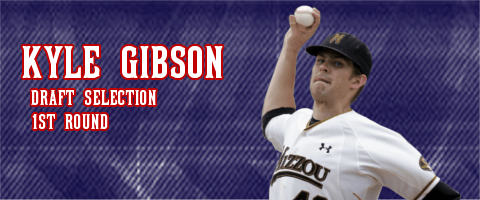
Back in 2006, Kyle Gibson was selected out of high school in the 36th round by the Philadelphia Phillies. The young right-hander opted for college, and for the past three years he spent his time pitching in the Big 12 for the Missouri Tigers.
Ranked as high as number four on draft prospect lists by Baseball America, the Twins were pleasantly surprised that the youngster fell their way. With the 22nd pick in the first round, the Minnesota Twins made Gibson their pick.
After this past season, it was discovered that Gibson had a stress fracture in his right forearm. The injury was not considered serious, and since being selected in the June draft, Gibson has went through rehab and is now completely recovered.
With one week remaining before the signing deadline, Gibson remains unsigned along with many other first round picks. The young righty was kind enough to answer some questions for an interview.
Voice From Twins Territory: Growing up, who was your favorite baseball team, and who were some of your favorite players?

Kyle GibsonGrowing up my favorite team was the Reds. But I have a buddy, Jake Fox, who is now with the Cubs and ever since they drafted him they have been my favorite team.

VFTT: What current player would you say you’re most like and why?

KG: Other than the difference in velocity, I feel I’m most like Justin Verlander. A tall, skinny guy who just allows his body to work with his arm.

VFTT: You were ranked as the 4th best draft prospect by Baseball America. What is it like to get that type of recognition and what does it mean to you?

KG: To get that type of recognition is awesome! God has blessed me with the talents that I have and parents that really care about me, so that helps as well. Without them I would not have been able to get as far as I have.

VFTT: Where were you when you were drafted by the Minnesota Twins, how did you find out, and what was the feeling like?

KG: I was in my front yard watching it on TV with a bunch of friends and family, and it was a great feeling!

VFTT: Since being selected, what has the entire process been like?

KG: The process has been very protocol for a first round pick. There was a long time where nothing got done because we were waiting on my arm to heal. But now the negotiations are working and going pretty good.

VFTT: You suffered a fracture in your right forearm prior to the draft. Where are you in the recovery stage, how difficult has it been to handle, and what do you believe was the cause?

KG: My arm feels great. I have been throwing for about two and a half weeks and it feels awesome! It was a crazy five days once I found out, but everything worked out for a reason. We believe the cause of the stress fracture was just throwing while tired and not getting enough rest and recovery.

VFTT: The good news on the injury front is that it isn’t a long term thing. Do you expect to have the same velocity, movement, and repertoire as before? And, is it true that you were going to take this time off before pitching again anyways?

KG: It is true that I was going to take 6-8 weeks off anyways. I had thrown five or six complete games and heard somewhere that I averaged 110 pitches per start. That is including a start of 45 pitches at Oklahoma State and a start of 70 in the Big 12 tourney. So my arm had a long year and it needed some rest! As for my return, I should be as healthy and as strong as before. My forearm should actually be stronger than it was before because that is just the trend with stress fractures. My arm feels really fresh right now so I should have all the velocity, and the change up has felt as good as ever this early in my return so that is good as well.

VFTT: What do you feel is your biggest strength, and what is one thing you’re looking to most improve upon?

KG: My biggest strength is probably the fact that I can throw all three of my pitches for strikes in any count. I pride myself on that and not walking guys. My biggest thing I need to work on would probably be making sure my stuff is as good from the stretch as it is from the wind up. I got much better at that this year but still need to work on that.

VFTT: What is your goal for the rest of the year, and what are you looking to do in the off-season?

KG: My main goal for this fall is to get back into the swing of things on the mound and get my comfort level back after taking time off. I also want to make a good impression in my first couple months as a Twin.

VFTT: Through little league, high school, and college what is your greatest baseball moment?

KG: I think my favorite baseball moment is a three way tie. My senior year I was one strike away from back-to-back no hitters in the post season! Then two of them from this year are the fact that I was able to throw a complete game in five of my first six Big 12 games with all of them being against teams ranked in the top 25 at that time; that was a blast. The favorite being against number one Texas. Then the last one was this year as well. Being able to throw 15 innings to end the year without giving up a run, and doing it all with a stress fracture and not knowing it! That was fun and it was challenging at the same time.

VFTT: Who is one person or a few people who helped you along the path to get into professional baseball?

KG: I would say my dad is the biggest person who has helped through the years. He has been able to help me in every way I have needed and it has been great to have a family like mine who can back me all the way.

VFTT: What do you think it would be like to make a major league debut with the Twins?

KG: I get really excited to think about my major league debut and I think it will be an absolute blast to do it with the Twins! I hope that I can get up there as soon as possible and help contribute wherever I can.

VFTT: The Big Question – How confident are you that you’ll sign by the August 17th deadline?

KG: Right now I am not sure how confident I am. That is an issue that will be figured out on Monday.

Quick Five:

Favorite baseball movie? For Love of the Game
Superstitions? None
Pre-game meal? I love a good steak, but never have a chance for that pregame. Anything really, just as long as my stomach is nice and full!
Do you wear a particular number? #44 for college, and just because it was the number available to me. It has grown on me!
Weirdest thing someone has said to you at a game? In high school my junior year when I was about 6’3″ and 160 pounds someone yelled, “Hey daddy long legs, throw the ball!” That’s the funniest thing I’ve heard.
I’d again like to thank Kyle for taking some time to answer these questions and wish him the best of luck with his signing and hopefully his future with the Minnesota Twins organization.

Homestand Highlights: Royals and Indians

Homestand Highlights (8-11).png
After a week long trip that included stops in Cleveland and Detroit, the Minnesota Twins return home and continue their schedule against American League Central rivals. The week long homestand will include series with the Kansas City Royals and Cleveland Indians.
Aside from the on-field highlights ranging from Justin Morneau taking on the Royals, a team he has the most career homeruns against, and Carl Pavano taking on the team that traded him away a week ago, there will be many highlights at the ticket office and Metrodome gates.
 

 August 11th vs. Royals
The Game: The Royals will send righty Kyle Davies (3-8, 6.37) and the Twins will counter with second-year pro, Nick Blackburn (8-6, 3.79).
The Tickets: It’s a Pepsi Half-Price Tuesday presented by My29, and you can sit in the Homerun Porch (a $21 ticket) for just $10.50.
The Highlight: If you’re going to spend time at the concession stand, you might as well be full doing it. For a $34 ticket, you’ll get not only entry to the game, but you’ll also enjoy all the hot dogs, popcorn, nachos, peanuts, pretzels, fountain pop, and water you can handle.
 August 12th vs. Royals
The Game: Brian Bannister (7-8, 3.78) will take on Francisco Liriano (4-11, 5.63).
The Tickets: All students with a valid student ID can purchase a Cheap Seats ticket for only $4.
The Highlight: It’s another Hormel Dollar-A-Dog Night and all fans (limit two) can buy hot dogs for just $1.
 August 13th vs. Royals
The Game: In a daytime matchup, Gil Meche (4-9, 4.50) will return from the disabled list to take on either Anthony Swarzak or Brian Duensing.
The Tickets: Presented by KQRS FM, with the purchase of a Homerun Porch Ticket or $5 off a Lower Reserved Ticket, fans will receive a free Dome Dog and soft drink.
The Highlight: All kids 14 years under will receive a Library Day Poster presented by Lerner Publishing.
 August 14th vs. Indians
The Game: The newly acquired Justin Masterson (3-3, 4.42) will throw between 75 and 80 pitches against Carl Pavano (10-8, 5.09) who will make his second start as a Twin against the team that recently traded him away.
The Promotion: It’s a Cub Foods Fantastic Friday, and with the purchase of a Homerun Porch ticket, fans will receive a coupon for a free half-gallon of milk or orange juice from Land O’ Lakes redeemable at a Cub Foods location.
The Giveaway: The first 10,000 fans receive a Commemorative Lanyard and Ticket Holder courtesy of MLB2K9.
 August 15th vs. Indians
The Game: David Huff (6-6, 6.72) will take on a Twins team that has given him a 10.24 ERA this season. The Twins will likely counter with Scott Baker in the 3:10 CT game.
The Highlight: For $37, fans will get a pass to the Tailgate Party presented by Fox Sports North. The pass includes entry to the barbeque, a Twins cap, and autographs from Twins’ alumni.
The Giveaway: The first 5,000 fans 18 and older will receive a Twins Card Wallet courtesy of Spire.
 August 16th vs. Indians
The Game: The Indians pitcher is to be determined, but in the 1:10 CT matchup, the Twins will likely send Nick Blackburn to the hill.
The Promotion: It’s Blue Bunny Kids Day, and two kids 14 and under will receive free admission with the purchase of an adult ticket in the Homerun Porch or Cheap Seats.
Ride a Bike: All fans who ride their bike to the game, will be able to park their bike for free in a secure bike corral and will receive $5 off a lower reserved or upper club ticket.

Finding Spans Position

While Minnesota Twins’ outfielder Denard Span has found his spot in the team’s lineup as the leadoff hitter, his true position in the team’s outfield has remained a question in his first full season as a major league player. 
After making his debut last season as a replacement for then injured right fielder Michael Cuddyer, Span consistently took the field in right. In a total of 104 defensive games last season, Span was in right field for 85 of them and in centerfield for the other 19.
This season that consistency has been unfound. With four outfielders, including one whose primary position is centerfield, Span has found himself hitting leadoff everyday and playing musical chairs in the field.
So far this season, Span has been the starter in left field 39 times, centerfield 42 times, and right field only 12 times. For now, Span will play anywhere so long as it’s a starting role. In time however, even as soon as next season, Span will be looking to remain in one full time location.
What position Span will field is still in question, but there is one of the three that Span fields best, and it just might work perfectly. According to the numbers, Span’s best defensive position is left field; with 23-year old Carlos Gomez the hopeful future in centerfield and Michael Cuddyer currently a mainstay in right, the question may answer itself.
Span Defense.png
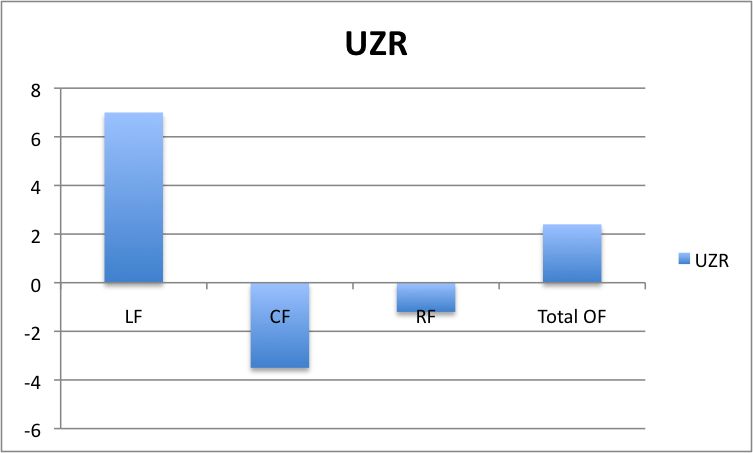
The UZR takes into account several different factors including a fielder’s range. Each player has a positive or negative number which shows how many runs above or below average a fielder is at a given position.
This season Span has a UZR of 7.0 in left field, -3.5 in centerfield, and -1.2 in right field. With only 12 starts in right this season, his right field statistic may not be accurate (he had a rating of 7.1 in right field last season), but his numbers in center and left have a much larger sampling. 
Span’s UZR/150 for left field, which shows how many runs a fielder saves or costs his team over 150 defensive games, is 17.6 – seventh best among players with at least 350 innings.
Span has been greatly valued this season as a leadoff hitter and table-setter for All-Stars Joe Mauer and Justin Morneau. He’s found his position in the lineup, and finally maybe, in the field as well.

O-Cab Carries Leadership

O-Cab.jpg
Orlando Cabrera arrived in Minneapolis last Saturday after the Minnesota Twins made a deadline deal in an attempt to help shore up their middle infield and add production from the second spot in the lineup. Since his arrival Cabrera has without a doubt been a productive player. The veteran shortstop has went 10-20 at the plate in five games to give him a .500 batting average since his arrival, and he’s made several professional plays in the field.
The offense and defense are two things the team knew they had the chance of receiving when Cabrera was acquired, but there is one other thing that Cabrera carries – leadership. From the first time Cabrera stepped foot on the Metrodome turf, it was easy to tell the type of person he was away from the batter’s box.
After Cabrera grounded out to second base in his first at-bat as a Twin, he went to the dugout and let everybody know what the pitcher was trying to do. The next time up, Cabrera took a nearly identical pitch down the right field line for a double.
Veteran leadership is one quality that Cabrera carries, so too is his mentorship. From his first inning as a Twin through his 45th, Cabrera has been seen time and time again sitting and talking with youngster Carlos Gomez. The mentorship has paid off.
Gomez has gone 4-15 in four games since Cabrera’s arrival to give him a .267 average in the near-handful of games. The 23-year old speedster has shown more confidence, hit pitches he didn’t earlier in the season, and continued to make strong plays in centerfield. 
If the Twins are playing meaningful baseball come October, Cabrera could be a key factor. His leadership and ability to communicate with young players such as Gomez however could have an impact on the many seasons ahead.

Tracking the Attendance

While most of the league has seen a decline in attendance this season, the Minnesota Twins have been one of few teams who have remained unscathed. In fact, the Twins have seen an increase in attendance from last season.
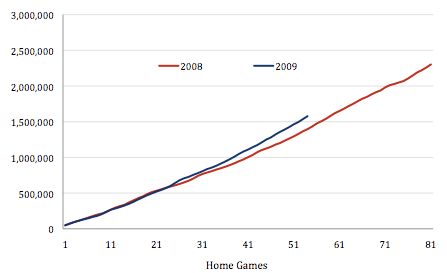
Thus far, the Twins have played a total of 54 home games and have an average attendance of 29,212 fans. Last season through 54 games at the Metrodome, the team was averaging 25,841 fans. The difference of 3,371 fans per game is quite spectacular with the economy and the downfall in attendance in most other markets.
Attendance (8:05).png
In the last 20 home games, the Twins have drawn at least 30,000 fans to 17 of them. The three games that have not drawn 30,000 fans have drawn over 27,000 once and over 29,500 twice. In that span, there have been four 40,000-plus games and two others have been within 1,000 fans of the mark.
Overall this season the Twins have drawn 1,577,429 fans compared to a total of 1,395,409 fans to the same point in 2008. The difference is over 180,000 fans and the team still has 27 games to widen the gap.
The league average for attendance is currently on pace to be just above 2,400,000 fans at season’s end. To reach that mark, the Twins will need to draw about 30,000 fans per game over the next two months. If the team remains in the division race, that is more than doable; last season the team finished with just over 2,300,000 total fans.
Attendance Analysis will become a series updated at various points the rest of this season and in the future.

It Begins Now

Literally the season starts in April, but figuratively, for the Twins at least, their trip through Cleveland and Detroit marks the beginning of the ‘real season’. For the first four months of the year, the Twins have managed to play .500 ball and stick within two games of the lead in the American League Central; now the team will focus on divisional opponents for the final two months in an attempt to play meaningful games in October.

In the first half of the season, the Twins played only 29 of their total 72 divisional games. The second half schedule consists of 43 divisional games, and beginning with the team’s stop in Cleveland, 40 of 58 remaining games will be played in the Midwest against the Central.
The first half of the season wasn’t easy for the Twins as they played one of the top five toughest schedules in baseball. They completed all scheduled games with the Yankees and Red Sox while their foes, Chicago and Detroit, did not. 
The second half of the season is statistically easier, and with Cleveland’s recent fire sale, things could be easier than what other teams will face in August and September. No team will roll over however, and many players are out to prove they belong – thus the team will need to play well despite an easier opponents winning percentage.
Up to the start of a week long road trip, the remaining schedules for Detroit, Chicago and Minnesota are as follows:
Detroit:
Minnesota – 10
Kansas City – 9
Tampa Bay – 7
Cleveland – 6
Chicago – 6
Boston – 4
Toronto – 4
Baltimore – 3
Seattle – 3
Oakland – 3
Los Angeles – 3
Chicago:
Boston – 8
Minnesota – 6
Los Angeles – 6
Seattle – 6
Kansas City – 6
Detroit – 6
Cleveland – 6
Oakland – 5
Baltimore – 3
New York – 3
Cubs – 1
Minnesota:
Cleveland – 12
Kansas City – 12
Detroit – 10
Chicago – 6
Texas – 7
Toronto – 4
Baltimore- 3
Oakland – 3
While the Tigers and White Sox each have 11 remaining games against the American League East powers (Boston, New York, Tampa Bay), the Twins have completed that portion of the schedule. That section alone could help the Twins as the Tigers have a .385 winning percentage against the East this season.
The Twins have positioned themselves well for the final two months, and consistency against their own division in the next eight weeks could help the Twins to a division title. Nothing will be given to them however, and while the Indians and Royals have struggled and take up nearly half of the remaining schedule, the Twins must be prepared for a new season, one that starts now.

Deadline Aftermath

Heading into the trade deadline, all eyes were on the big market teams: the Yankees, Red Sox, Blue Jays, and others. All the talk was about Roy Halladay and what his destination would be. In the end, Halladay would stay put and the Yankees were inactive in any big moves.

The big markets for the most part stayed put (with the exception of the Red Sox acquiring Victor Martinez), and the division that currently has three teams making a run at the playoffs, the American League Central, made the moves.
The first big move came when the Detroit Tigers unexpectedly jumped in and acquired Jarrod Washburn from the Seattle Mariners. Washburn will be gone at the end of the season, but for the final two months, the move has a chance of bolstering an already pretty good rotation.
Hours later the Twins countered with a move of their own; they sent a minor league shortstop, Tyler Ladendorf, to Oakland and brought in shortstop Orlando Cabrera with hope that the middle infield in Minneapolis will see more production. 
As the deadline passed, it seemed as though the Tigers and Twins were the only contenders in the Central to make major moves. Reports then began rolling out with word that for a second time, the White Sox had traded for pitcher Jake Peavy.
The deal was soon finalized and Peavy will indeed be in Chicago. Whether or not Peavy will help the team this season however is questionable. Peavy has been on the disabled list since the first week of June, won’t be back before the first week of September, and may not pitch again this season.
While the Cleveland Indians scrapped their team and looked to the future by trading Ben Francisco, Ryan Garko, Cliff Lee, and Victor Martinez, the Tigers, Twins and White Sox each took shots at bolstering their rosters for the final two months of the season.
Only time tell who exactly made the biggest move, but for now at least it seems as though the Twins and Tigers, with Peavy’s current injury, made the biggest impact on the 2009 season.

Twins Acquire Orlando Cabrera

The Minnesota Twins have traded minor league shortstop Tyler Ladendorf to acquire the shortstop from the Oakland A’s, Orlando Cabrera. After weeks of speculation, the team made the move and gave up far less than the initial reported asking price of Danny Valencia.

Ladendorf was a second round pick in 2008 and has been playing for the Beloit Snappers after starting the season with the Elizabethton Twins. At the Rookie level, Ladendorf hit .410 in 17 games. His promotion to A-ball has brought struggles as he hit just .233 at Beloit.
Ladendorf was not ranked among the top ten prospects within the organization by Baseball America. 
The addition of Cabrera gives the team potential for more production from the middle infield. Through 101 games, Cabrera hit .280 with 4 homeruns and 41 RBI as the shortstop in Oakland. His month of July has stood out as the deadline neared. In July, Cabrera has hit .373 with 2 homeruns and 16 RBI for one of the lowest scoring offenses in baseball.
Cabrera will wear number 18 for the Twins and hopes to be in uniform for tonight’s game. There is no information on how the team will make room on the 25-man roster.

A Collective Effort

On any given night, only ten players (including the pitcher) take the field to start the game. It leaves a handful of starting pitchers, relievers, and position players on the bench. Those select starters may help decide the outcome of one game, but over a full season it takes a collective effort from all 25 players.

Injuries call for players to step up, as do slumps. When an everyday player goes out, someone needs to be there to keep things moving smoothly. The same goes for starting pitchers and relievers after long streaks of work.
As the Twins got ready to take the field against the Chicago White Sox and go for the sweep of a three-game series, the realization of baseball being a team effort was clear. Starter Francisco Liriano was set to take the mound, but last minute inflammation in his throwing arm knocked him out.
With hours to go until the first pitch, the Twins were faced with a decision. In the end they called upon rookie Brian Duensing to make his first major league start in a key divisional game. The lefty went five innings, allowing just two solo homeruns, and leaving with only 64 pitches and his team tied for the lead.
Duensing stepped up for his team, and went from being a long reliever to a spot starter in moments notice. The Twins also received strong efforts from Alexi Casilla and Carlos Gomez although they’ve at times struggled this season.
The middle part of the lineup (Mauer, Morneau, and Kubel) in the three-game set with Chicago went a combined 3-27 to give them a .111 batting average for the series. What might normally hurt the team did not as the Twins received strong performances from players who stepped up, much like Duensing did in his major league starting debut.
It may be the everyday players and the All-Star that set the tone, but without backups and players who can step up in a moments notice, contending is only an afterthought.