Category: Dailies

Off-Season Outlook: Review

Review.png
Less than two days into the official off-season, and before there was any time to look at the team’s options, the Minnesota Twins made a move. With the acquisition of shortstop J.J. Hardy from Milwaukee, the team set the tone for what could be a busy off-season in Minneapolis. 
The trade for Hardy did many things: it took the number of infield question marks from three to two, it cleared up an outfield logjam, and it created an opening for a fourth outfielder.
Second base and third base remain open, the bench remains unsettled, and the rotation has openings too. So while the Twins put a dent in their to-do list, more is expected in the next three-plus months. 
Infield 
With Hardy at short and Morneau at first, the Twins have half of their infield set for the 2010 season. Recent comments by management suggest Punto will too be part of the equation, either as the second or third basemen.

If Punto is indeed already penciled in to start to the left or right of Hardy, the Twins will need to fill the one remaining void via trade or free agency. 

At second base, a good option seems to be Placido Polanco. The veteran doesn’t strikeout much, plays a good second base, and hit 10 homeruns and drove in more than 70 runners last season. 
If third base is the void, Adrian Beltre has drawn interest from the team in recent seasons and recently qualified as a Type-B free agent, meaning the Twins wouldn’t lose a draft pick. 

Bench 
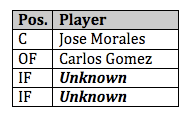
The bench has questions, but most, if not all of them, will be solved within the organization. There are likely to be four bench spots; one catcher, two infielders, and one outfielder. 
A starting lineup with Punto would leave Brendan Harris, Matt Tolbert and Alexi Casilla as the three strongest candidates for two backup infield spots. Jason Pridie would be the leader to back up Delmon Young, Denard Span, and Michael Cuddyer, but a veteran leader and powerful hitter might help. The final bench spot, for Joe Mauer’s backup, is likely to be Jose Morales if the team moves forward without Mike Redmond. 
Starting Rotation
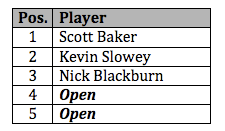
If the team so chooses, the 2010 starting rotation could be filled completely in-house. Scott Baker, Kevin Slowey and Nick Blackburn seem to be locks, leaving two spots unfilled. 
One or both of the spots could be filled with a combination of left-handed starters Francisco Liriano, Glen Perkins or Brian Duensing. The Twins could use one or none of those options and fill the remaining openings via free agency. 
Jarrod Washburn is a player the Twins have watched for the past few seasons, and the team reportedly claimed Rich Harden off waivers this past season. Meanwhile, a low-risk signing of Ben Sheets could pay big dividends, and the team is interested in re-signing Carl Pavano.
Bullpen 
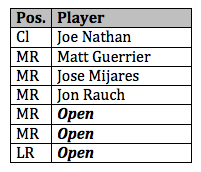
The rest of the pitching staff, which will likely consistent of twelve spots, will almost certainly be filled with current players. Joe Nathan, Matt Guerrier, Jon Rauch and Jose Mijares all seem to be locks, leaving three spots open for competition. 
Among the competitors are Jesse Crain, Pat Neshek and Boof Bonser. A few starters may be in the mix with Liriano, Perkins and Duensing possibly moving out of the starting role. 
Free agency is just days away and the Twins will undoubtedly be in the mix for infielders and starting pitchers. With the payroll likely to see and increase, the wait is on to see just how active the team will be.

The 2010 Payroll

The Minnesota Twins still have questions remaining after their trade with the Milwaukee Brewers. While shortstop has been solved, second base, third base, and the rotation have not been. 
As the off-season starts to get underway with arbitration offers, free agency and front office meetings, the Twins will have some payroll flexibility. Most teams, including the Twins, don’t publicize their plans for payroll. With that said, reports indicate that the team’s 2010 payroll could jump somewhere around $90 million.
While the jump would be nearly $25 million more than the team ended with in 2009, it is smaller than it seems. Players like Joe Mauer, Justin Morneau and Scott Baker are moving further into contracts and being awarded more guaranteed money. In addition, nine players will receive raises via arbitration.
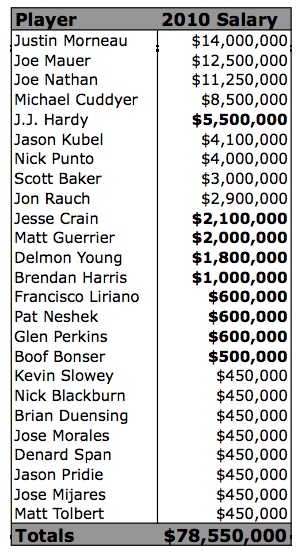
With the raises and arbitration estimates based on various reports and opinions, the team’s payroll may be very close to the following before any signing or other trade occurs.
2010 Payroll.png
The total of $78.55 million may be a little low if the players gain more than the shown estimates through arbitration, and it could be lower if any of the nine players are non-tendered (not offered a contract).
When all is said and done, it seems as though the team’s payroll will climb more than $10 million just with arbitration and players advancing in current contracts. If reports of a $90 million payroll are correct, the Twins will have around $12 million or so to help bring in a starting pitcher and potentially fix second base, third base, or both.
* In bold are rough estimates of contracts after arbitration.

Hello Hardy, Goodbye Gomez

It didn’t take long for the off-season to get started for the Minnesota Twins. Less than two days after the conclusion of the World Series, the team put a dent in their to-do list with a trade. 

With the infield filled with uncertainty outside of first base and Justin Morneau, it came as no surprise that the team’s first area of action was shortstop. In possibly the first of many off-season moves, the Twins sent Carlos Gomez up I-94 to Milwaukee and brought in 27-year old shortstop J.J. Hardy. 
Gomez had arrived in Minnesota two seasons ago when the Twins sent Johan Santana to New York in exchange for four players. A speedy outfielder, Gomez showed signs of promise, but upon his departure, his skills at the plate remained a question. 
Hardy meanwhile put up great numbers in 2007 to help earn a spot on the National League All-Star team. The numbers were matched again in 2008, but Hardy never rebounded from a slow start in 2009 and saw one of baseball’s top shortstop prospects, Alcides Escobar, take his spot. 
Since the 2005 season, Minnesota Twins’ shortstops have hit a combined .253 with 31 homeruns, and 287 runs batted in over the course of five seasons and 810 games. In that same span, Hardy has hit .262 with 75 homeruns and 265 RBI in 571 total games. 
Not only will the Twins potentially add power to the lineup, they’ll also add defense to the infield. Considered one of baseball’s best shortstop defenders, Hardy made eight errors last season giving him a .983 fielding percentage. 
While Milwaukee adds a replacement for Mike Cameron, the Minnesota Twins have answered two questions. Come spring, there will be no questions regarding the state of the outfield; Delmon Young, Denard Span, and Michael Cuddyer will start. 
Meanwhile, a position filled with uncertainty since Christian Guzman manned the spot in 2004 will now become more stable. Hardy is under the team’s control through 2011, and if he can rebound from a tough season, his tenure could last longer. 
Second base and third base remain as two of many questions, but quickly into the off-season, the Twins have already addressed one of their biggest holes.

Off-Season Outlook: Bench

Bench.png

Bench Spots.png

While sometimes an unnoticeable section of the roster, the bench played an important part in the Minnesota Twins’ success during the 2009 campaign. Without Alexi Casilla’s hit and Carlos Gomez’s run in the division tiebreaker, the team would have saw no division title and no playoffs. 
There will be plenty of options to fill what will likely be four bench spots for the 2010 season. Nick Punto and Matt Tolbert will still be under contract next season, and Brendan Harris will be too if the Twins choose to offer him arbitration. With only two spots open for infielders, one player may be left out unless one of the three gains a starting role. 
The fourth outfielder, which seemed to be Carlos Gomez down the stretch, will take one of the four spots and likely be the guy to provide rest on a regular basis for the other three outfielders. 
Despite options, two big questions remain as the off-season begins. Mike Redmond has been a key veteran presence for the team since his arrival, but after several seasons in Minneapolis, his contract has expired. The Twins have catcher Jose Morales ready to be Joe Mauer’s backup, and another young catcher, Wilson Ramos, is on the way. 
Aside from deciding whether to thank Redmond and move on with a younger group or bring the veteran back for one more season, the Twins have one weakness in the bench.

In recent seasons Rondell White, Craig Monroe, Ruben Sierra and others have become the power hitters off the bench. With two middle infielders and a small power outfielder on the bench so far, the Twins may be looking toward free agency for a player to provide some pop at Target Field.

Off-Season Outlook: Lineup

Lineup.png

Hitting Lineup.png

Normally a small-ball team, the 2009 season was an odd one for the Minnesota Twins. For the first time since 1987, the team had four players with at least 25 homeruns, and for the first time ever, four players climbed over the 90 RBI mark in a single season. 
With Justin Morneau, Joe Mauer, Michael Cuddyer and Jason Kubel all back next season, the lineup seems to be in pretty good shape as the Twins begin the off-season. 
The outfield is seemingly set with Denard Span, Cuddyer and a suddenly powerful Delmon Young. There will without a doubt be rumors involving Young yet again this year, but a move seems unlikely. Carlos Gomez meanwhile provides a fourth option off the bench and a solid defender for late-game situations. 
The big question for what seems like the fourth consecutive off-season is the infield. Since the days of Corey Koskie, Christian Guzman and Luis Rivas, the infield has been a game of musical chairs. 
Third base has seen Tony Batista, Nick Punto, Brian Buscher, Brendan Harris and Joe Crede; shortstop has seen Juan Castro, Jason Bartlett, Punto, Harris, Alexi Casilla and Orlando Cabrera; and second base has seen Luis Castillo, Casilla, Punto, Harris and Matt Tolbert. 
Uncertainty has been the name of the game when looking at the infield outside of first base and Justin Morneau. For yet another year the off-season will include deciding who will make up the three remaining positions. 
Third Base 
Joe Crede hit 14 homeruns and drove in 40 runners, but another back injury ended his season early yet again. Another incentive-laden deal seems plausible, but other options might be more viable for Minnesota. 
The free agent market isn’t the deepest, but names such as Adrian Beltre, Chone Figgins, Melvin Mora, Troy Glaus, and Mark DeRosa make it interesting.

Beltre is a player the Twins have eyed for two seasons, but a steep demand for young talent has made him hard to get, Figgins is a speedy veteran who can play multiple positions, and the rest have, in recent years, had decent production. 

Shortstop 
The easy answer at shortstop would be to re-sign Orlando Cabrera. The veteran shortstop mentioned several times in his short tenure with the team that he’d be open to returning, and the Twins were undoubtedly happy with his late-season production. The big question seems to be what Cabrera will demand and what Minnesota feels he’s worth. 
Outside of Cabrera and two Type-A free agents, Marco Scutaro and Miguel Tejada, the free agent market for shortstops is less-than-stellar. Milwaukee shortstop J.J. Hardy’s name has been popular, and the 27-year old might be a nice fit. 
Hardy was demoted last season in favor of prospect Alcides Escobar. Since being demoted, Hardy’s name has been popular is trade talk and many fans seem to like the idea. The Brewers would almost certainly demand pitching, but it’s uncertain how much. 
Second Base 
Alexi Casilla was supposed to be the future of the position when Luis Castillo headed off to New York, but since that time it’s been a combination of Casilla, Harris, Tolbert and Punto at the middle infield spot.

If the Twins make moves with the left side of the infield, Punto might suffice as the starter on the right side along with Morneau. If not, there are a few options on the market. 

Type-A free agent Orlando Hudson would cost a draft pick, but might be a player capable of filling the spot for more than one season. Felipe Lopez had a pretty good season, and a popular name early on is Placido Polanco. After playing for the Tigers he may be looking for a new home, and the Twins know first hand what he can do. 
The top half of the lineup, filled with the mainstays of Span, Mauer, Morneau, Cuddyer and Kubel, seems set. Three primary openings remain however, and who the former MVP will play alongside is still very much uncertain.

Off-Season Outlook: Bullpen

Bullpen.png

Pen.png

Last off-season one of the biggest questions regarding the roster was the bullpen. The Twins would have no Pat Neshek or Boof Bonser, and Matt Guerrier was coming off a poor season by his standards. 
A year later the only question that remains is who will win the three current openings. The Twins have often went with twelve pitchers on their pitching staff, and the assumption is that they’ll do the same in their first season at Target Field. 
Closer Joe Nathan will be one of four locks for the bullpen as the Twins begin spring training action four months from now. He’ll be joined by Matt Guerrier, Jon Rauch and Jose Mijares. 

With four spots determined, the Twins have three to fill and an abundance of options from within the organization. It’s likely that as many as six players will complete for three sports with the losers potentially out of options in Minnesota. 
Jesse Crain is one option, and the Twins will have a decision to make on him in the coming months. A poor start to the season saw him demoted to Triple-A, but Crain rebounded and played a key role down the stretch. The powerful right-hander is arbitration eligible and the Twins will need to determine what he’s worth. 
Outside of Crain the Twins will have several other options. Ron Mahay is a free agent left-handed specialist whom the Twins acquired down the stretch, and Bobby Keppel saw a lot of time in 2009 out of the bullpen. The Twins also have at least one minor league option in Anthony Slama. The youngster pitched well in the organization this past year and may be given a close look. 
Injuries kept both Neshek and Bonser off the field last season, and while it’s hard to know what they might be able to provide in 2010, they’ll both be given the shot to show the organization this spring. 
Free agency doesn’t seem to be needed this off-season in regards to the bullpen as the Twins have several options to compete for three openings. Decisions will need to be made, but it’ll come down to performance and health in March.

Off-Season Outlook: Rotation

Rotation.pngStarting Pitchers.png
An area that wasn’t supposed to be in question this past season became a big one with injuries. With Scott Baker, Nick Blackburn, Kevin Slowey and a healthy Francisco Liriano, the rotation looked to be a strength for the Twins as they took the field in April. 
Baker got off to a slow start after an injury-filled spring, Slowey collected ten victories but missed the second half, Perkins missed several starts with arm problems, and Liriano was inconsistent before being shut down and eventually moved to the bullpen. 
Players stepped up however as rookie Anthony Swarzak made a few good starts and rookie left-hander Brian Duensing stepped into the rotation and played a key role in the team’s September run. Meanwhile, grizzled veteran Carl Pavano provided leadership and quality starts time and time again after being acquired in a midseason trade. 
As the team looks ahead to Target Field and the 2010 season, questions do remain with only three of five rotation spots currently seemingly guaranteed. Scott Baker, Nick Blackburn and a healthy Kevin Slowey seem to be locks for the rotation, but two slots remain unsettled. 
The Twins have three likely options within the organization including Francisco Liriano, Glen Perkins, and Brian Duensing. They could fill both slots with two of the three pitchers, but a better option seems to be to fill one spot and go outside of the organization to fill the other.
If the Twins go with one of the three lefties to fill one of the bottom spots in the rotation, they’ll have one opening to fill via trade or free agency. Carl Pavano stepped up for the Twins and overall pitched nearly 200 innings with the Indians and Twins combined. Pavano may be a good option who can provide innings when healthy in addition to leadership.

Trades are always possible, but outside of Pavano the best options lie within the free agent market. 

Jarrod Washburn is another lefty who the team has reportedly eyed for the past two seasons. The lefty put up good numbers, and has stated before that he’d love to play closer to his home state of Wisconsin. 
The Twins have three spots currently decided, and if they so choose, the rotation could all be filled within the organization. A pitcher like Pavano, Washburn or another free agent might however be a wise investment to fill at least one slot.

Off-Season Outlook: Preview

Preview.pngNearly seven months removed from Opening Day, baseball’s final two teams have just about been decided. That means there will soon be 28 teams moving on to 2010 with the off-season packed full of free agency, trades, arbitration and more. 
After a great, memorable year in Minnesota in which the Twins ended the season on a 17-4 run to win the American League Central and close out their 28 year tenure in the Metrodome, the organization will now begin a new era with Target Field on the horizon.
The off-season is a great time; it’s filled with rumors, hopes and eventually moves. Some teams will upgrade while others will stand pat. For the Twins, holes have opened up in the infield, and the next three-plus months will be telling times with nine arbitration cases, several free agents, and gaps to be filled.
In the days ahead there will be several off-season outlooks for several areas including the rotation, bullpen, lineup and bench. 

Attendance Analysis: A Final Look

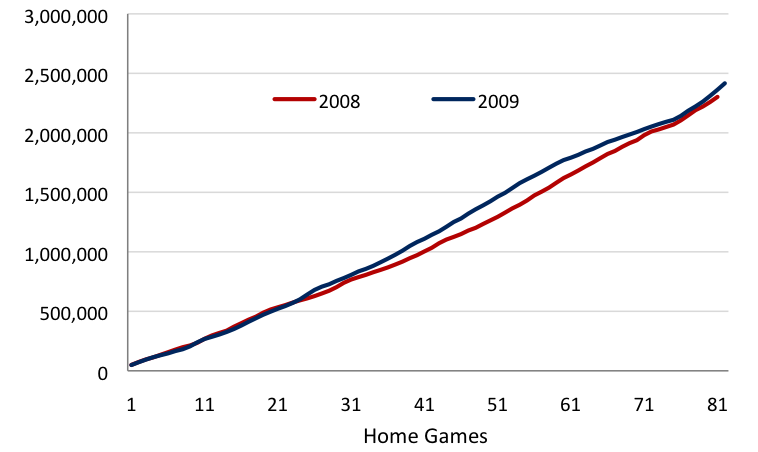
There were many interesting moments over the course of the final season in the Metrodome, and many fans turned out to see them. In the first 81 regular season games, the total attendance ranked third all-time for the Minnesota Twins; second only to 1988 and 1992, the two years following the team’s World Series titles.


(1) 3,030,672 – 1988 
(2) 2,482,428 – 1992 
(3) 2,362,149 – 2009 
(4) 2,302,431 – 2008
(5) 2,296,347 – 2007 
(6) 2,293,842 – 1991 
(7) 2,285,018 – 2006 
(8) 2,277,438 – 1989 
(9) 2,081,976 – 1987 
(10) 2,048,673 – 1993
It would take 82 home games before the team’s fate could be decided however, and in the final Metrodome game, a regular season record, 54,088 fans showed up to take the 2009 regular season attendance total to 2,416,237 for the season.

Attendance Final 09.png
In 2008, the team averaged a total of 28,405 fans per game. This season, in the final season indoors, the Twins averaged 29,466 fans per game, an increase of 1,405 fans per game. Overall, the team brought in 113,806 more fans in 2009 than last season to give them the third highest attendance in team history.

The average attendance around Major League Baseball in 2009 was right around 2,400,000; with an extra game the team was able to surpass that.
With an expected capacity of 39,800 at Target Field next season, the most fans the team could draw in 2010 is 3,223,000. After making the playoffs, and with 2010 being the Inaugural Season at Target Field and the 50th Season in Minnesota for the organization, next season could see historic attendance totals.

It’s Over

After an improbable comeback and an appearance in the
playoffs, the season for the Minnesota Twins has come to an end. There will be
no long playoff run, no more Metrodome magic, and no World Series title. The
off-season begins immediately, and what had been a great run has come to a
sudden halt.

It’s not time to think back about what could’ve been, and
it’s not time to recount the missed opportunities in the American League
Divisional Series. There is no changing what has happened, and time can be
better spent.

It’s instead time to remember the final memories made under
the Teflon roof this past season. From historic moments to deadline deals to
great moments and great games, the 2009 campaign was a memorable one – with or
without playoff success.

There were the franchise firsts and the baseball firsts;
there were the deadline deals; there were great games; there was an improbable
comeback; there was a final Metrodome playoff game; there was time to remember
the 28 seasons under the roof; and for the fifth time, there was a celebration
for the American League Central.

They say history is always changing, but who could have
thought the Twins would be rewriting so much of it in one season. From Joe
Nathan’s new team record of 47 saves, to multiple team firsts, the past season
was a historic one in Minnesota. For the first time since 1987, the Twins had four
players with 25 or more homeruns in a single season; and for the first time in
franchise history, four players collected at least 90 RBI.

Team history was changing, but the Twins didn’t stop there,
they also rewrote baseball’s history book. Before the team did it last week, no
team in the history of the game had ever overcome a three-game deficit with
four games remaining. And before Joe Mauer hit .365 as a catcher this season, the
highest single-season batting average for a catcher was .3617.

Some have criticized Bill Smith in his short tenure as the
team’s general manager, but his mid-season moves played a huge role in the
final months. Where would the team be without Carl Pavano, Orlando Cabrera, Ron
Mahay and Jon Rauch? Maybe the playoffs would have still become a reality, but
there is no denying that those four players were major factors.

The acquired players helped the team overcome many
difficulties, and without Joe Crede, Glen Perkins, Kevin Slowey and Justin
Morneau, the Twins finished the season with a 17-4 run to overcome a seven-game
deficit in four weeks.

The comeback in itself was historic, but the team made one
more mark in the Metrodome’s history with it’s first ever tiebreaker game. The
extra-inning victory was home to the largest ever regular-season Metrodome
crowd, and it assured one more playoff game indoors with one final divisional
title.

From the incredible comeback to the many incredible moments
in game 163, the final season at the Dome was a memorable one. The ending was
not enjoyable, but the moments that got the Twins to that point were. While
an era in team history comes to a close, the memories and historic moments will
forever remain.